A Historical Walking Course Through Sites Connected to the Kamakura Shogunate
The charm of walking through Kamakura is not limited to the sea, temples and shrines, or the nostalgic scenery of the Enoden railway. Throughout the town, quiet traces of the Kamakura Shogunate still remain.
Kamakura was the place where Minamoto no Yoritomo established the base of Japan’s first samurai-led government. With Tsurugaoka Hachimangu Shrine at its center, the town developed as a symbolic city of the samurai era. Today, Kamakura is a popular sightseeing destination, but once you learn a little about its history, the familiar streets begin to look completely different.
In this article, we will introduce a historical walking course through sites connected to the Kamakura Shogunate. The route includes Tsurugaoka Hachimangu Shrine, the grave of Minamoto no Yoritomo, the Hokke-do Site associated with Hojo Yoshitoki, Wada-zuka, and the Hase and Sakanoshita areas.
This course is recommended both for first-time visitors to Kamakura and for those who have visited before and would like to experience the city from a deeper historical perspective.
TOC
Understanding the History of the Kamakura Shogunate Makes Walking Through the City More Enjoyable
When Japanese people hear the words “Kamakura Shogunate,” many remember the phrase they learned in school: “Ii kuni tsukuro Kamakura Bakufu,” referring to the traditional date of 1192. Today, there are various views regarding the exact year of its establishment, but Kamakura was undoubtedly an important place in Japanese history as the center of a warrior government.
When Minamoto no Yoritomo made Kamakura his base, the area developed as a center of politics, military power, and faith. Tsurugaoka Hachimangu Shrine is still introduced today as a shrine that developed together with the Kamakura Shogunate and as a cultural starting point of Kamakura, the city of samurai.
As you walk around Kamakura, you will notice that places with deep historical significance are scattered close to lively sightseeing areas. Beyond the busy Komachi-dori shopping street stands Tsurugaoka Hachimangu Shrine. In a quiet residential area lies the grave of Minamoto no Yoritomo. Near an Enoden station remains Wada-zuka.
Each of these places may not be a large tourist facility. However, once you know the background, you can truly feel that the entire town of Kamakura was once a stage of Japanese history.
Start at Tsurugaoka Hachimangu Shrine, the Heart of Kamakura
If you are walking through places connected to the Kamakura Shogunate, Tsurugaoka Hachimangu Shrine is the best place to begin.
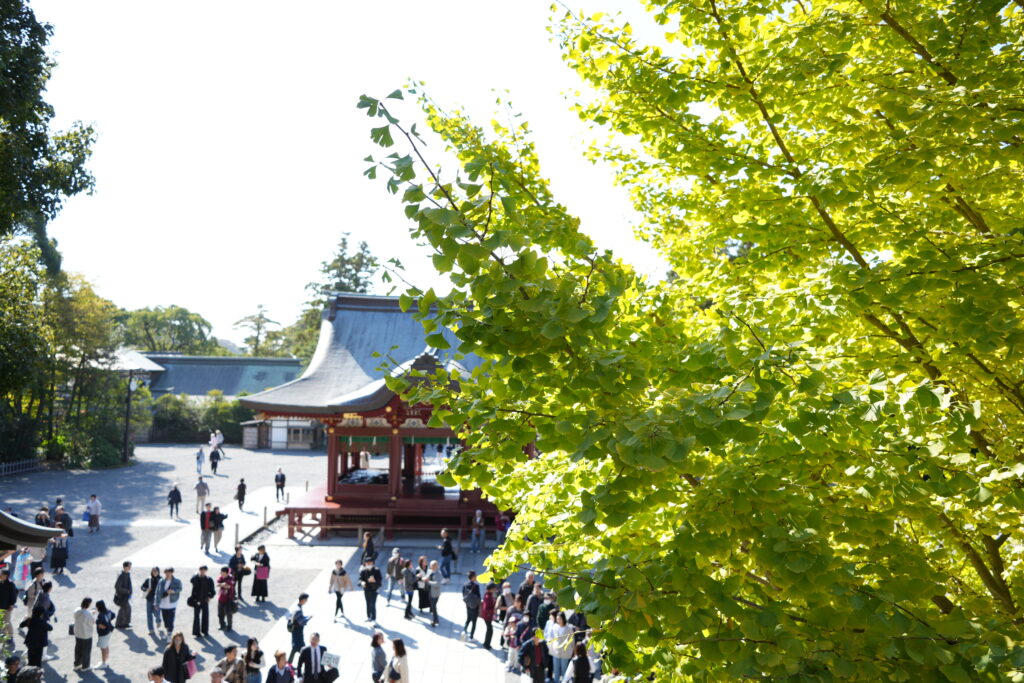
Tsurugaoka Hachimangu is one of Kamakura’s most famous sightseeing spots, but it is also essential when thinking about the history of the city. According to the shrine’s origin, it began when Minamoto no Yoriyoshi, an ancestor of Minamoto no Yoritomo, enshrined the deity of Iwashimizu Hachimangu Shrine from Kyoto. Later, when Minamoto no Yoritomo established his base in Kamakura, the shrine became central to the town’s development.
Walking along Wakamiya Oji, the approach to the shrine, you can feel that Tsurugaoka Hachimangu was not simply a shrine, but also the center of Kamakura’s urban design. The straight road leading from the seaside, the raised path called Dankazura, and the shrine building visible ahead all create a powerful sense of direction and history.
Even as a sightseeing route, it is a beautiful walk. But if you imagine how Yoritomo may have envisioned the town, the experience becomes even more meaningful.
Inside the shrine grounds, first visit the main shrine, then take your time walking around the area. The scenery changes with the seasons: cherry blossoms in spring, fresh greenery in summer, autumn leaves, and crisp clear air in winter.
Tsurugaoka Hachimangu Shrine is an ideal starting point for a historical walk. From here, your journey tracing the footsteps of the Kamakura Shogunate begins.
Visiting the Grave of Minamoto no Yoritomo, Founder of the Shogunate
A short walk from Tsurugaoka Hachimangu Shrine leads you to the grave of Minamoto no Yoritomo.
The site of Yoritomo’s grave is said to have once been the location of his private Buddhist hall. After his death, it came to be known as Hokke-do. The stone pagoda that stands there today is said to have been moved from O-mido in 1779 by Shimazu Shigehide, and the site is designated as a National Historic Site.
Unlike the lively atmosphere around Tsurugaoka Hachimangu, the area around Yoritomo’s grave is quiet and calm. After climbing the steps, you reach a grave site that feels less like a tourist attraction and more like a place for quiet reflection.
Standing there, you may feel that the man who founded the Kamakura Shogunate ultimately came to rest in this very land. Yoritomo is often remembered as a historical figure from textbooks, but when you stand before his grave, he feels less like a distant figure from history and more like a person deeply connected to the town of Kamakura.
There are also other sites related to the Hojo clan and the Kamakura Shogunate nearby. If you have time, it is worth exploring not only Yoritomo’s grave but also the surrounding historical area.
The Hokke-do Site and Hojo Yoshitoki: Traces of the Hojo Clan That Supported the Shogunate
Near the grave of Minamoto no Yoritomo, there is also a place connected to Hojo Yoshitoki, an essential figure in the history of the Kamakura Shogunate.
According to Kamakura City, the graves of Minamoto no Yoritomo and Hojo Yoshitoki, the second regent of the Kamakura Shogunate who greatly contributed to the establishment of the warrior government, are designated together as the Historic Site of Hokke-do Ato, including the graves of Minamoto no Yoritomo and Hojo Yoshitoki.
Hojo Yoshitoki was an important figure who supported the structure of the Kamakura Shogunate after Yoritomo’s death. The warrior government that Yoritomo created did not continue through his power alone. It was maintained and developed by influential gokenin, or vassals, including the Hojo clan.
Walking around the Hokke-do Site, you can feel that the center of the Kamakura Shogunate was not limited to Tsurugaoka Hachimangu Shrine. It also extended into the surrounding valleys and foothills.
Kamakura is a town surrounded by mountains on three sides and open to the sea. This unique geography helped shape Kamakura as the base of the shogunate.
As a sightseeing spot, this area may not be visually dramatic, but for those interested in history, it is deeply atmospheric. The memory of the Kamakura Shogunate remains quietly within a peaceful residential area. That quietness itself is one of Kamakura’s unique charms.